I decided to take a better look at hive #2, our strong hive, and see if there are swarm cells, if they need more space, etc. Whereas other years I've had difficulty with the hive being honey bound early, this hive has a problem of being brood bound. This queen is some egg layer! The hive is so full of brood, capped and otherwise, that I thought I would add some brood to hive #1 which, if it has a new queen who will begin laying within the next several days, will need newly emerged bees to help with the work of taking care of the new eggs/larva, gather pollen/nectar, etc. You can see the solid laying pattern in the photo below, with just a few drone cells along the top edge.
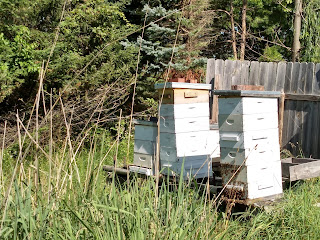
Although I didn't find the queen, I found plenty of brood, capped as well as very young. I put the frame above into hive #1, then put a similar frame, with bees, into the little 5 frame nuc box below as well as a frame of honey and one of pollen and nectar. I finally found a frame with some eggs and young larva and put that into the nuc as well. I set it on the far side of the prairie. With luck, We'll be up to 3 hives in about a month's time.
The queen cell in hive #1 was empty and mostly removed by the bees. According to the calendar, she should be able to start laying eggs early next week. I just hope there were enough viable drones around to be able to mate.
Bessie's Bees
Kathy, (aka "Bessie"), and I began our beekeeping experience in the fall of 2008, when we began a year-long course in beekeeping through the Indian Creek Nature Center in Cedar Rapids, Iowa. We got our first package of bees in April of 2009. At the suggestion of our daughter, Jessica, we are logging our beekeeping experience. Hope you find it interesting. It has been interesting, rewarding and entertaining for us as well.
Friday, May 17, 2013
Tuesday, May 7, 2013
Queen Cells
It has been 9 days since we did a split and time to check to see if queen cells are being made.
As you can see, they had one capped cell on this frame and another, off the image, that was in the process of being capped. We didn't interfere any further with the hive, which has a good number of bees present. I know some probably migrated back to the original hive but since we put several frames with a lot of brood, the hive has a good population in spite of being situated near the original hive. I know most experienced beekeepers will tell you you need to move them a couple miles away, but so far I haven't had any problem losing too many bees back to the original hive. Nice to be lucky about something!
Kathy was noting how many different colors of pollen are coming in right now. You can see the young lady above loaded down with huge sacks of orange. There is such variety of plant blooming right now (see the cherry blossoms below) and the bees have a lot from which to choose. It would be interesting to see what the honey produced by this variety is like, but at this time of the year, the nectar they harvest gets turned into honey to replenish what they lost over the winter, so by the time we get to filling supers, our honey here comes more just from sweet clover. Still, pretty darn tasty!
As you can see, they had one capped cell on this frame and another, off the image, that was in the process of being capped. We didn't interfere any further with the hive, which has a good number of bees present. I know some probably migrated back to the original hive but since we put several frames with a lot of brood, the hive has a good population in spite of being situated near the original hive. I know most experienced beekeepers will tell you you need to move them a couple miles away, but so far I haven't had any problem losing too many bees back to the original hive. Nice to be lucky about something!
Kathy was noting how many different colors of pollen are coming in right now. You can see the young lady above loaded down with huge sacks of orange. There is such variety of plant blooming right now (see the cherry blossoms below) and the bees have a lot from which to choose. It would be interesting to see what the honey produced by this variety is like, but at this time of the year, the nectar they harvest gets turned into honey to replenish what they lost over the winter, so by the time we get to filling supers, our honey here comes more just from sweet clover. Still, pretty darn tasty!
Saturday, April 27, 2013
Lighting a Smoker Video
I posted a new little video, 5 minutes long, below, showing how I light the smoker. After seeing fairly regular comments about difficulties lighting smokers on message boards, I decided to make this video. I used to take much longer to get mine started, but this technique seems to pretty much always work fine for me.
With temps forecast to be above 70 degrees tomorrow, I plan to do a split. I'll move the queen, provided I can find her, into the new hive, with some capped brood, plenty of honey and pollen frames, and will make sure there are frames with eggs and young larva left in the other hive. I'll do a follow-up post to tell how that goes, hopefully with some photos.
Update: We did the split today, but were unable to find the queen even though we did a very thorough search. There were eggs and a lot of capped larva in both the top and bottom boxes, with mostly honey, pollen and some new nectar in the middle box. We put several frames with eggs, young larva and capped brood in the new hive and closed things up. I'll check in a week and see if there is a queen cell being produced. The original hive appears very healthy, with many bees in each box.
With temps forecast to be above 70 degrees tomorrow, I plan to do a split. I'll move the queen, provided I can find her, into the new hive, with some capped brood, plenty of honey and pollen frames, and will make sure there are frames with eggs and young larva left in the other hive. I'll do a follow-up post to tell how that goes, hopefully with some photos.
Update: We did the split today, but were unable to find the queen even though we did a very thorough search. There were eggs and a lot of capped larva in both the top and bottom boxes, with mostly honey, pollen and some new nectar in the middle box. We put several frames with eggs, young larva and capped brood in the new hive and closed things up. I'll check in a week and see if there is a queen cell being produced. The original hive appears very healthy, with many bees in each box.
Subscribe to:
Posts (Atom)